algebra
Borderline embarrassing discussion of math below. If you are a math friend reading this lmk your thoughts.
With all this "rings" formatting thinking, I have also been thinking about algebra and algebraic rings again.
Quick intro is that a ring, represented as
(the set with only addition) is an abelian group, meaning: , i.e. addition is associative. , i.e. addition is commutative. - There exists an element
in such that ( contains an identity element). - For every
in , there also exists an in such that (all elements have an inverse).
- Multiplication is associative, i.e.
. - For all
in , the left distributive law, and the right distributive law hold.
Frankly, I was decent at Modern Algebra I but really remarkably bad at Modern Algebra II (one indicator of how my brain function deteriorated from seizures, tbh). So don't take me at my word with anything regarding algebra, in the present day.
Actually structuring this site as an algebraic ring is not possible as far as I am capable. While the inverse of a blog post might be a thing you could figure out, what would multiplying texts mean, and then what is the "identity text." How could adding texts be commutative? How could you possibly distribute a text (i meant in a math way, but I guess I am already distributing this text, so maybe there's a clue there).
Alternatively could do an algebra-inspired formatting thing throughout the site, but that may be a little too heady for me.
Idk, mostly I wanted to write the above to see how Obsidian inline math formatting holds up in this garden, and it works pretty well.
Groups might be more approachable though!
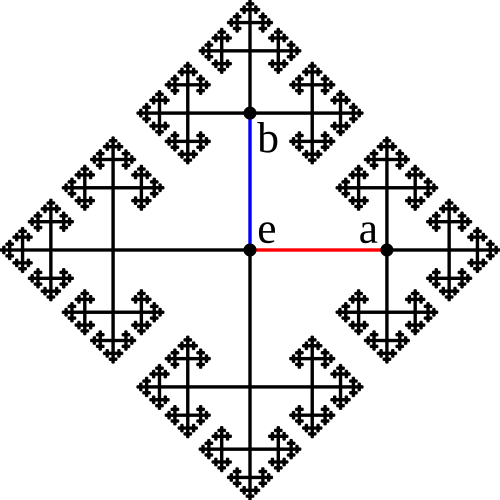
This image of a Cayley graph of the free group on two generators is reminiscent of this site's structure but it's absolutely not the same at all in any way. But it's pretty! And I am not quite sure what the free group is, I think I learned about it but don't remember any details.
The graphs of the links and nodes of some parts of this website sorta remind me of cyclic groups and their cycle graphs! Cyclic groups were one of the only things I was able to wrap my head around in Algebra II, and I really like them. Could think about this.
Dihedral groups (symmetries of a polygon) are another thing I really liked in algebra. And are maybe also approachable for making a gardening of this form at some point. It would be really fun to structure a piece or collection of writing/narrative around all its symmetries, like the figure below:
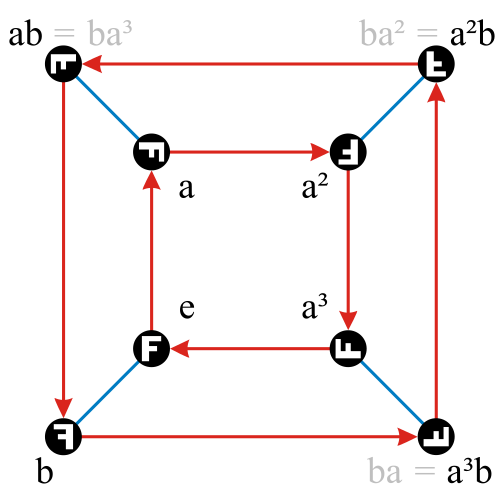
Cayley graph of
These ideas are remarkably fuzzy. If any math friends read this let me know if you have any ideas that are less fuzzy (or fuzzy in a more orderly way).
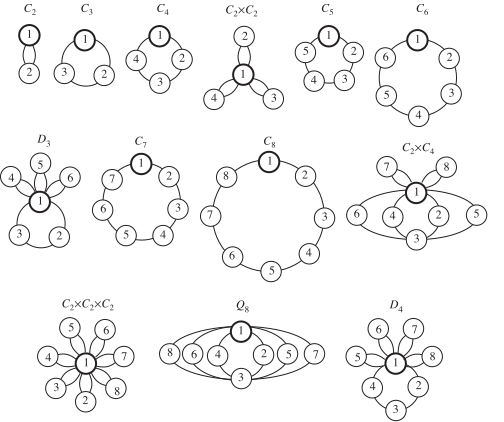
Some of these depictions of cycle graphs have me thinking too...
While I'm talking about groups, shoutout to my favorite frieze groups, which I gave a presentation on shortly after John Conway died and it made my professor cry. Groups you can dance to, as he described.

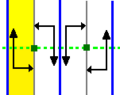
The "spinning sidle" frieze group is a fun one to leave in the snow that is on the ground right now (late January, 2026). But be careful!! The other ones would be fun too, probably, but beware the spinning hop.