Audio excerpt from Q'iwanakaxa/Q'iwsanakaxa Utjxiwa by Chuquimamani-Condori and Joshua Chuquimia Crampton
06-23-2023, MoMA PS1, Queens, New York
Full work title:
Q'iwanakaxa/Q'iwsanakaxa Utjxiwa (Cacique apoderado Francisco Tancara & Rosa Quiñones confronted by the subprefecto, chief of police, corregidor, archbishop, Reid Shepard, & Adventist missionaries)
Lots of text description and additional context below.
Audio Description
A sonic collage of many layers. Starting from the background, there is the sound of a strong synthetic wind slowly oscillating in pitch, with some thunder-like crashes within it, later joined by the sound of a slow and high warning siren. In front of those, in middle ground, is the sound of an accordion-like instrument taking slow, deep, musical breaths. These are all the kinds of sounds you feel in your entire body.
In the close foreground is the sound of a mother or an aunt speaking familiarly to an interviewer, telling a story in English. My best attempt at transcription is:
"Your Grandma Flora... had a scar near her... thumb, on her left hand, and she um... we asked her what was... what happened there, and she told me that when she was 3 years old, she was traveling from La Paz to Rosario by train, and the train [word I can't make out ]... the farthest that it went to reach Rosario was this town in Camacho..." [recording end]
[END TEXT DESCRIPTION]
Notes
*The oral history interviews were playing only in headphones, while the music played on speakers, filling the whole room. I took this recording while holding a pair of headphones up to my phone mic.
*I am not 100% certain I correctly interpreted the place names in this transcription. "Rosario, Ayllu Pahaza, Calacoto in the Pacajes province" is listed in the museum program as being the artists' ancestral hometown, and then La Paz and Camacho Province are major geographic landmarks nearby. So, these are educated guesses. An aside, but I noticed that the Spanish language Wikipedia page for Pacajes is so so much more detailed than the really paltry English Wikipedia article for Pacajes. I cannot find much information online about Rosario in particular, but I did find this image of la Iglesia de Rosario in Calacoto. It is beautiful.

Visuals
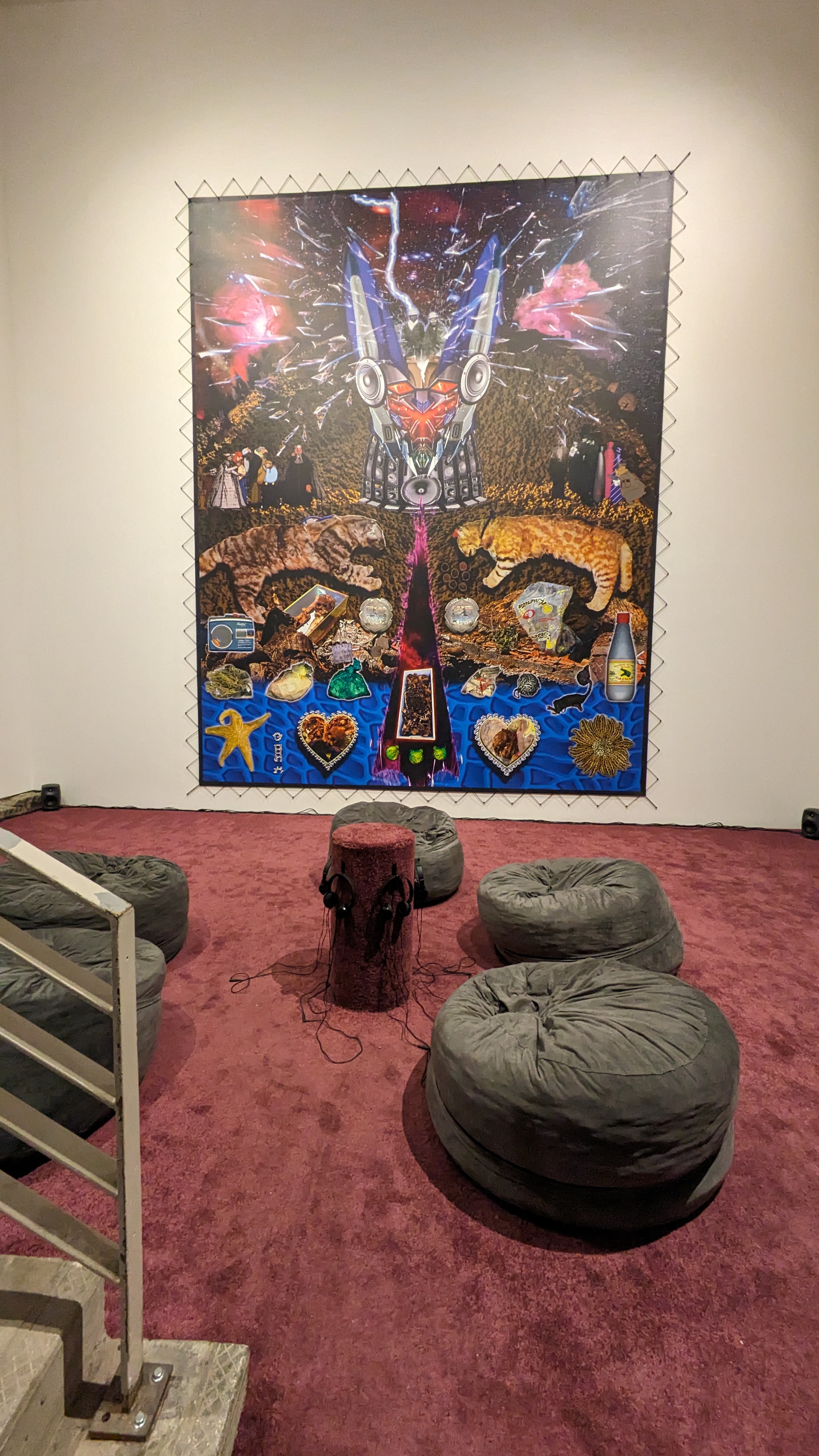
Text description: photograph of the full installation room, showing a large mural hanging on the wall with a kaleidoscopic composition, featuring something that looks like Optimus Prime's robot head, lightning bolts, a rip in space and time, people, two large Andean mountain cats, textures of space and the earth and the sea, and a lot of other stuff going on that I could not effectively list. The best descriptors I can come up with are "assemblage," "meaningful chaos," "Aymara sci-fi," "exploding outwards," and "you feel it rushing over and through your body."
The room has a deep red carpeted floor in front of the mural. In the center of the floor is a short column covered in the same carpet, with five pairs of headphones hanging on hooks. It is encircled by bean bag chairs, one for each pair of headphones. [end text description]
*I generally want to avoid including images and relying just on audio in this section of the site, but I think it's necessary in the context of this work that is not mine.
Photo taken by me.
More Info
Work Information
From the museum exhibition program:
This immersive new work incorporates sound, music, and image, interlaced with personal stories from the artists’ mother, aunts, and grandparents in honor of their great great-grandparents, Francisco Tancara and Rosa Quiñones. Tancara and Quiñones were part of a movement that asserted the Aymara people’s legal land titles, built schools when native education was criminalized, and practiced freedom of religion—activities for which they were persecuted by the Catholic church and Bolivian state. By continuing the anti-colonial and anti-ecclesiastical labor of the artists’ elders, the multifaceted image and sound work articulates possibilities for an abolitionist Indigenous queer future.
According to the Bandcamp page of the artists' musical collaboration Los Thuthanaka, the Aymara language title of "Q'iwanakaxa - Q'iwsanakaxa Utjxiwa" translates to "The Queer People - Medicines Are Here" in English. I am not sure if the song on the Los Thuthanaka album that shares a title with the installation is the exact same song playing the background of the audio, but it contains near-identical textures.
The ISO 639 language code for Aymara is "ay", and so I have wrapped all instances of the language in a <span> element with an Aymara language tag. I am curious if most screen readers are equipped for it.
Personal Background
I saw this work in June 2023, while in the design process of the central on-site installation for Okaeri: The Nisei Legacy at Shofuso. This work directly inspired that installation, and I am grateful for it.
The experience of descending into the double-height room from hardwood floor to concrete stairs to high-pile carpet released something in me, something similar to what is released when ascending up the shikidai at Shofuso. Something you feel when entering the presence of ancestors.
The central installation we came up with was located in the dimly-lit 10-tatami room at Shofuso, featuring a low table with floor cushions surrounded by three large screens. The front screen played a slideshow of archival images, the left played archival footage of the installation of the house in Philadelphia from the video diary of the lead carpenter, and the right played archival footage of the Shofuso's 1999 hinoki roof replacement, which featured sound of the dampened hammering of hinoki bark together. Speakers played a compilation of excerpts from oral histories with members of the original Friends of the Japanese House and Garden and other community elders and camp survivors. On the table rested reproductions of archival pamphlets from Japanese American post-war resettlement for public interaction. The sounds of the garden (waterfall, birds, wind, visitor footsteps and murmuring, etc.) bled through the walls.
Q'iwanakaxa/Q'iwsanakaxa Utjxiwa's welcoming of ancestors, history, and imagination through the layering of oral history over ambient sound with restful and grounding seating directly helped to welcome my own ancestors. Again, I will be forever grateful to the piece. Thank you.
I may add a sonic excerpt of Okaeri to this gardening, but I need a break right now.
More Links
- Link to Spanish transcription and English translation of Silvia Rivera Cusicanqui talk at the "Indigenous and Migrant Justice Symposium," held at MoMA PS1 on March 13, 2023.
- Los Thuthanaka Bandcamp page
- Los Thuthanaka Wikipedia page
- Chuquimamani-Condori Bandcamp page
- Chuquimamani-Condori Wikipedia page
- Joshua Chuquimia Crampton Bandcamp page